Earthquake Research Facility at the U of M, University of Minnesota, UMN Twin Cities
 
NEES
 
UMN
 
NSF


What's Inside
Home

About NEES@Minnesota

Facilities

Projects

Publications

Training Information

Personnel

Activities and News

Links

Visit Us

Contact Information
Site Map

Telepresence

Photo Gallery


  MAST System.
 
Lab Manager (right) demonstrating use of the MAST control pod to undergraduate assistant
 
Welcome to the MAST Laboratory

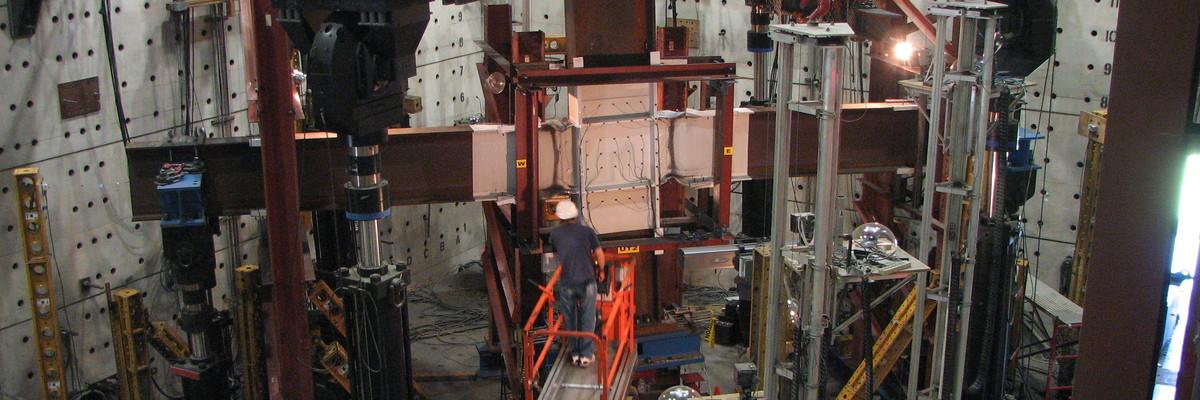
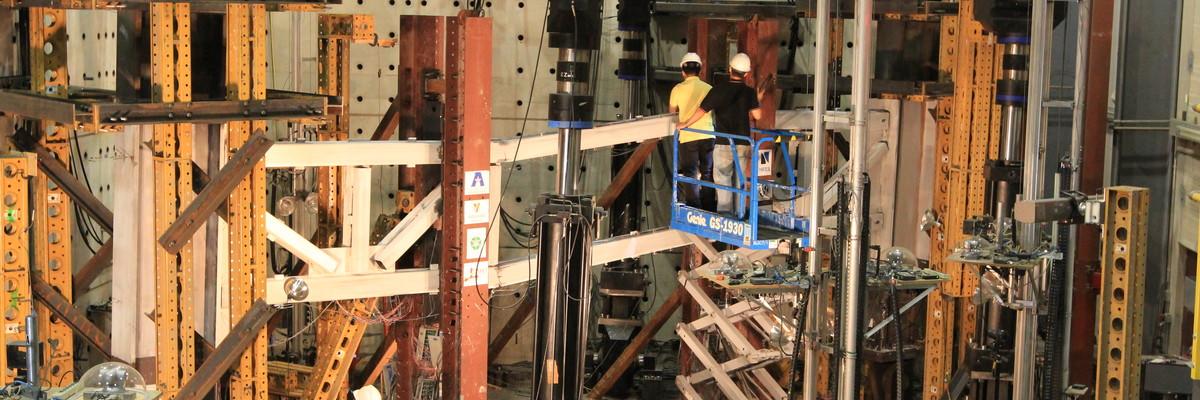
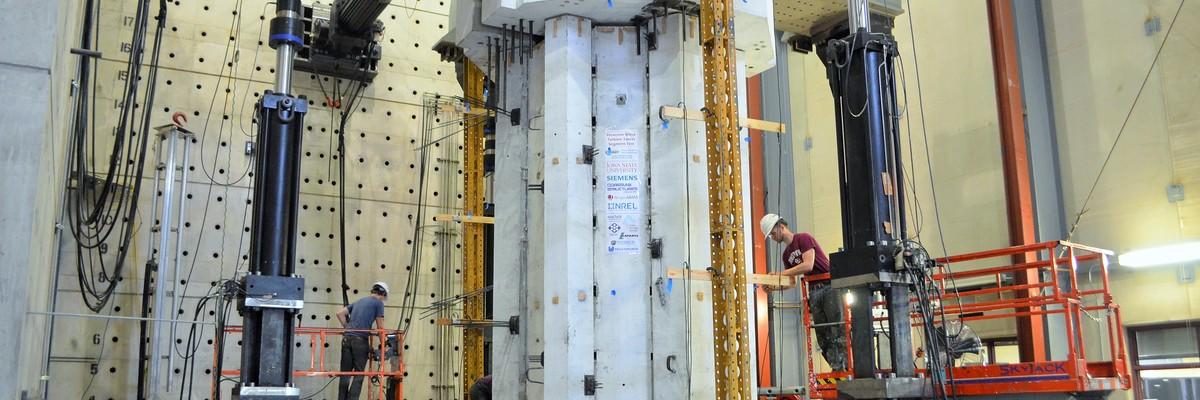
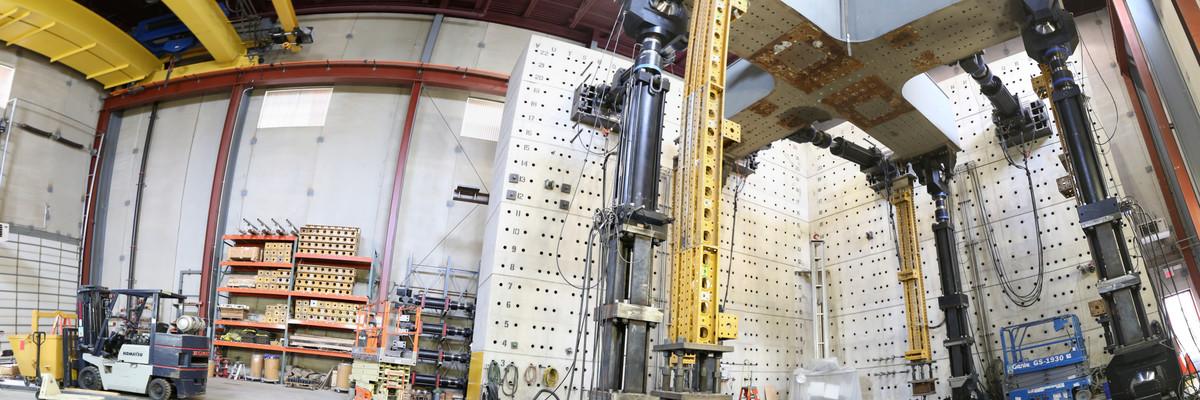
    The Multi-Axial Subassemblage Testing (MAST) Laboratory, located on the Minneapolis campus of the University of Minnesota, comprises one node of the George E. Brown, Jr. Network for Earthquake Engineering Simulation (NEES). NEES is a national, networked, simulation resource that includes geographically-distributed, shared-use, next-generation experimental research Equipment Sites built and operated to advance earthquake engineering research and education. The MAST Laboratory is open for use as a national laboratory for researchers and for contract testing by private companies across the country who are interested in conducting large-scale testing and simulations on the integrity of structures subjected to earthquakes, wind, and other extreme loadings.

    The goal of NEES is to accelerate progress in earthquake engineering research and to improve the seismic design and performance of civil and mechanical infrastructure systems. Read More About NEES

    The MAST system specializes in three-dimensional, quasi-static, cyclic testing of large-scale structural test specimens. The six degrees-of-freedom of the MAST system may be controlled in any combination of displacement or load control modes. Master-slave relations may be used to link degrees-of-freedom, and four ancillary actuators may be positioned anywhere within the testing area. The MAST Laboratory includes extensive computational and archiving facilities, and the Laboratory supports interactive remote teleparticipation of experimental research as part of the NEESgrid system. Read More About MAST


Tours
 
Tours may be scheduled on the fourth Thursday of every month between 12pm - 2pm (next scheduled tour date is Thursday, May 22). If you are interested in participating, please contact us 1 week in advance.

Please send all tour requests to or call (612) 626-9561.
 
 
What's New


Workshop photo
 
Proposal Writer's Workshop 2008 Materials Available for Download
   Posted January 7, 2008
Presentations, demonstration materials, and travel reimbursement form for the MAST Proposal Writer's Workshop held on January 3, 2008 are available for download.


MAST Lab Rendering
 
Proposal Writer's Guide (v3.0)
   Posted January 4, 2008
This guide contains information about the MAST system, examples of test specimens, site access policies, and budget and schedule considerations that a researcher preparing an NSF proposal may find helpful. As we continuously improve and expand the contents of this guide, please check back periodically for new versions of the guide.


MAST Lab Rendering
 
Proposal Writer's Workshop 2008 (January 3, 2008)
   Posted November 27, 2007
NEES@Minnesota will hold a workshop for prospective proposal writers on January 3, 2008. This one-day training workshop will provide information necessary to develop a research proposal that takes advantage of the capabilities of the MAST system.

To register, please email or call Jane Zirbes at 612-626-7617. Space is limited. Registration will close on December 21, or when all spots are filled.

Download the workshop flyer. For additional logistical info, please see the training section of our website.


Workshop photo
 
MAST 3D CAD Drawing
   Posted January 26, 2007
A 3D rendering of the MAST system is available for download. This drawing can be used for presentation or for preparing figures in research proposals.

Download the CAD drawing. The drawing format is DWG.


MAST Lab Rendering
 
MAST System Artistic Rendering
   Posted February 15, 2005
A high quality image rendering of the MAST system in Photoshop file format. Download size: 37MB


Grand Opening
 
MN Daily Article on Grand Opening
   Posted September 22nd, 2004
The Grand Opening celebration was featured in the September 22, 2004 issue of the Minnesota Daily.


Grand Opening
 
MAST Laboratory Grand Opening
   Posted September 21, 2004
The Grand Opening was held September 21st, 2004.


Links
 
MAST Laboratory in the News
   Posted August 11, 2004
The MAST Laboratory was featured briefly in a news broadcast covering the 13th World Conference on Earthquake Engineering.


Links
 
Links
   Posted August 2, 2004
The new Links Page provides quick access to other sites related to NEES.


WCEE
 
13WCEE Paper
   Posted July 26, 2004
View the paper presented at the 13th World Conference on Earthquake Engineering on the MAST System.


Related Links
   

- About Us
- What is NEES?
- What's New?
- Visit Us
- Contact Info


Live Webcam

Visit our telepresence portal


Calendar Highlights.
   

9/12/2007 – NEESR-II HPFRCC Slab-Column Frame Test 3

7/23/2007 – NEESR-II HPFRCC Slab-Column Frame Test 2

6/5/2007 – NEESR-II HPFRCC Slab-Column Frame Test 1

1/4/2007 – NEES@Minnesota Proposal Writer's Workshop


Departments Supporting the MAST Laboratory
 

Civil Engineering
Electrical and Computer Engineering
Computer Science and Engineering
Institute of Technology


UMN MAST NEES Facility
The MAST testing facility is supported in part by the George E. Brown, Jr. Network for Earthquake Engineering Simulation (NEES) Program of the National Science Foundation under Award Number CMS-0402490. The MAST Laboratory building was funded in part by the University of Minnesota Office of the Vice President for Research, the Institute of Technology, the Department of Civil Engineering, and individual donors. The MAST Computer Infrastructure is jointly developed by the Department of Civil Engineering, the Department of Computer Science & Engineering, and the Department of Electrical and Computer Engineering.